Free professional gem identification tool by GEMIC Institute — enter what you observe and measure, narrow 138 gem materials (68 named varieties) to the compatible candidates, and learn the best test to run next.
Gem Identification — Free Gemological Assistant
Your equipment
How it works
Enter any observation or instrument reading, in any order. The assistant eliminates incompatible materials among 138 gem species, synthetic products and imitations. Classic varieties are covered: ruby and sapphire are corundum, while emerald and aquamarine are beryl. The assistant shows which candidates remain. It also recommends the test that narrows the list fastest. The result shows what your stone is consistent with. It never replaces laboratory certification.
Free for everyone. GEMIC Institute is a gemological laboratory, school and gem museum in Siem Reap. This assistant teaches the professional method. Our laboratory certifies the result when it matters.
The database contains 138 species and materials, including 68 named varieties. A variety such as emerald, ruby or tanzanite is the colour form of a species. It shares the physical constants of its species. The assistant identifies the species from your measurements. It then names the likely variety from the colour you selected.
Quick start — my stone is:
Recommended next test
Refractive index (refractometer)Specific gravity (hydrostatic weighing)Polariscope (optic character)Pleochroism (dichroscope)UV fluorescence — long waveUV fluorescence — short waveBirefringence (refractometer)Hardness (on rough material only)
Should narrow the list to about ? candidates.
Remaining candidates no longer separate with these tests — study the inclusions under magnification, or refer the stone to the laboratory.
Compatible species: The entered tests cannot distinguish the members of this group (natural / synthetic / imitation). Check the separation pointers in each card below, or have the GEMIC laboratory confirm.
138species & materials in the database · 68 named varietiescompatible species / materials · 0 matching varieties
109 materials are still compatible — too many to review usefully. Add at least one more criterion (the recommended next test above narrows fastest) and the candidate list will appear below 24 or fewer results.
Separation (nat. / syn. / imitations): 'Hematine' imitation: strongly attracted to a magnet (natural hematite is not); stamped intaglios show no carving marks.
Separation (nat. / syn. / imitations): Moissanite: visible doubling of pavilion facets through the table, whitish needle-like channels parallel to the optic axis, dispersion (fire) higher than diamond, positive on most thermal testers — use doubling to separate.
Syn. RutileSYNTHETIC
(Flame Fusion)
Growth method: Verneuil flame fusion (powder melted in a flame) — look for curved growth lines and gas bubbles.
Separation (nat. / syn. / imitations): Strontium titanate: fire far higher than diamond, no doubling (SR), soft polish lines, SG 5.13.
Sphalerite
Zinc Blende
RI2.369Birefringence—SG3.90–4.10Hardness3.5–4.0Optic characterDR / SR / (ADR)Crystal systemCubicTransparencyTransparent to opaqueUV long-wave—UV short-wave—ColoursBlack, Brown
In the GEMIC gem encyclopedia (photos & video):
Lead GlassMAN-MADE
Man-Made P.B.2.2
RI2.200Birefringence—SG6.65Hardness—Optic characterSRCrystal systemCubicTransparencyTransparent to translucentUV long-wavenonUV short-wavenonColoursColourless, Yellow
In the GEMIC gem encyclopedia (photos & video):
CZ (Syn. Cubic Zirconia)MAN-MADE
Skull Melt
Growth method: Skull-melt crystallisation, the standard process for cubic zirconia.
RI2.150Birefringence—SG5.60–6.10Hardness8.5Optic characterSRCrystal systemCubicTransparencyTransparent to opaqueUV long-wavenon – modUV short-wavenon – modColoursColourless, Pink, Yellow, Orange, Red, Green, Blue, Purple, Brown, Black
In the GEMIC gem encyclopedia (photos & video):
Separation (nat. / syn. / imitations): CZ: heavy in the hand (SG ~5.7), rounded facet edges, orange dispersion flash, occasional tiny gas bubbles, reads over-the-limit; unworn girdle often 'sugary'.
Typical inclusions: Strong doubling of back facets, abraded facet edges ('paper wear'), diagnostic 653.5 nm absorption line (most stones).
Separation (nat. / syn. / imitations): Low (metamict) types: greenish, lower RI/SG/birefringence, fuzzy spectrum. Heated blue zircon is standard in the trade.
RI1.790–1.805Birefringence—SG4.40–4.64Hardness7.5–8.0Optic characterSRCrystal systemCubicTransparencyTransparent to translucentUV long-wave—UV short-wave—ColoursBlue, Green
AlmandineDIAGNOSTIC SPECTRUM
Garnet Group
RI1.766–1.820Birefringence—SG3.93–4.30Hardness7.0–7.5Optic characterDR / SR / (ADR)Crystal systemCubicTransparencyTransparent to opaqueUV long-wavenonUV short-wavenonColoursBrown, Pink, Purple, Red
Typical inclusions: Rutile needle silk (may give 4-ray star), zircon crystals with tension halos.
Easily confused with: Ruby, pyrope, spinel, rubellite. SR + spectrum separates from ruby.
Painite
RI1.787–1.816Birefringence0.029SG4.01–4.03Hardness8.0Optic characterDR U-Crystal systemHexagonalTransparency—UV long-wave—UV short-wave—ColoursBrown, Red
In the GEMIC gem encyclopedia (photos & video):
Grossular-AndraditeDIAGNOSTIC SPECTRUM
Garnet Group
Varieties by colour: Yellow+Green+Brown = Mali garnet
RI1.773–1.779Birefringence—SG3.66–3.68Hardness7.0–7.5Optic characterSRCrystal systemCubicTransparencyTransparent to opaqueUV long-wavenonUV short-wavenonColoursBrown, Green, Orange, Yellow
In the GEMIC gem encyclopedia (photos & video):
Star garnetPyrope garnetMalaya garnetColor change garnet
Separation (nat. / syn. / imitations): Colour-change and mixed garnets: intermediate RI/SG; magnetic response stronger than most gems (rare-earth content).
CorundumCOMMON TREATMENTSDIAGNOSTIC SPECTRUM
Varieties by colour: Red = Ruby · Blue = Sapphire · Pink+Orange = Padparadscha sapphire · Red = Star ruby · Blue+Grey+Black = Star sapphire
Typical inclusions: Fine rutile 'silk' needles meeting at 60°/120°, straight or angular colour zoning, healed 'fingerprint' fissures, small crystal guests (zircon with halos, spinel, mica).
Separation (nat. / syn. / imitations): Natural: straight/angular growth and intact silk. Verneuil synthetic: curved growth lines + gas bubbles. Flux synthetic: wispy flux veils, platinum platelets. Heated stones: broken or dotted silk, stress discs around crystals.
Easily confused with: Ruby vs red spinel, garnet, rubellite, red glass. Sapphire vs tanzanite, iolite, kyanite, benitoite, blue spinel.
Treatments seen: Quench crackled and flux; induced (to create fpt)
Separation (nat. / syn. / imitations): Verneuil (flame fusion): curved striae best seen immersed, scattered gas bubbles, chalky short-wave fluorescence in some colourless/pale stones, Plato lines in colourless.
Syn. Corundum — FluxSYNTHETICDIAGNOSTIC SPECTRUM
Growth method: Grown in a molten flux — look for wispy flux veils and platinum platelets from the crucible.
Separation (nat. / syn. / imitations): Flux-grown: flux residues in veils ('wispy fingerprints'), platinum or gold platelets from the crucible, sometimes untwinned clean areas. UV often stronger than natural.
Separation (nat. / syn. / imitations): Later-generation synthetics (Czochralski, hydrothermal, floating zone): very clean; look for subtle curved banding or nail-head spicules; unusually clean stone at commercial price = suspicion — lab confirmation advised.
GahnospinelDIAGNOSTIC SPECTRUM
RI1.740–1.780Birefringence—SG3.61–4.41Hardness7.5–8.0Optic characterSRCrystal systemCubicTransparencyTransparent to translucentUV long-wavenonUV short-wavenonColoursBlue, Green
Pyrope-AlmandineDIAGNOSTIC SPECTRUM
Garnet Group
Varieties by colour: Purple+Red+Pink = Rhodolite
RI1.755–1.765Birefringence—SG3.74–3.94Hardness7.0–7.5Optic characterDR / SR / (ADR)Crystal systemCubicTransparencyTransparent to opaqueUV long-wavenonUV short-wavenonColoursBrown, Pink, Purple, Red
Typical inclusions: Octahedral crystals alone or in 'fingerprints', iron-stained fissures.
Separation (nat. / syn. / imitations): Natural spinel is SR with no pleochroism (ruby is DR and dichroic). Verneuil synthetic: curved striae, gas bubbles, strong anomalous 'crosshatch' extinction, chalky green SW fluorescence in blues.
RI1.690–1.730Birefringence—SG3.15–3.55Hardness7.0Optic characterAGGCrystal systemCubicTransparencyTranslucent to opaqueUV long-wavenonUV short-wavenonColoursGrey, Green, Red
RI1.653–1.680Birefringence0.008–0.011SG3.20–3.40Hardness5.0–6.0Optic characterDR B+Crystal systemOrthorhombicTransparencyTransparent to translucentUV long-wavenonUV short-wavenonColoursBrown, Colourless, Green
In the GEMIC gem encyclopedia (photos & video):
JadeiteCOMMON TREATMENTS
Pyroxene Group
Varieties by colour: Green = Imperial jade · Violet+Purple = Lavender jade
RI1.614–1.655Birefringence0.022–0.027SG2.95–3.10Hardness5.0–6.0Optic characterDR B- / AGGCrystal systemMonoclinicTransparencyTransparent to opaqueUV long-wave—UV short-wave—ColoursGreen
Hemimorphite
RI1.611–1.639Birefringence0.022SG3.40–3.50Hardness4.5–5.0Optic characterDR B+Crystal systemOrthorhombicTransparencyTransparent to translucentUV long-wave—UV short-wave—ColoursBlue, Brown, Green
In the GEMIC gem encyclopedia (photos & video):
Lazulite
RI1.607–1.648Birefringence0.031–0.036SG3.08–3.17Hardness5.0–6.0Optic characterDR B- / AGGCrystal systemMonoclinicTransparencyTransparent to opaqueUV long-wave—UV short-wave—ColoursBlue, Green
RI1.608–1.627Birefringence0.008–0.009SG3.04–3.14Hardness7.5–8.0Optic characterDR U-Crystal systemHexagonalTransparencyTransparentUV long-wavenonUV short-wavenonColoursPink, Purple, Red
In the GEMIC gem encyclopedia (photos & video):
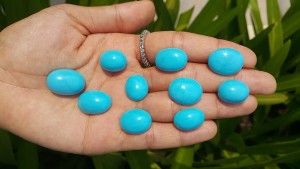
TurquoiseCOMMON TREATMENTS
RI1.610–1.650Birefringence—SG2.40–2.90Hardness5.0–6.0Optic characterAGGCrystal systemTriclinicTransparencySemi-translucentUV long-wavenon – wkUV short-wavenonColoursBlue, Green
In the GEMIC gem encyclopedia (photos & video):
TurquoiseYellow turquoise
Treatments seen: Zachery, Impregnation,; Dyed
Separation (nat. / syn. / imitations): Natural turquoise: matrix veins, colour variation; stabilised/waxed common. Gilson-type and imitations: uniform colour with dark blue 'pepper' spherules under magnification; dyed howlite shows colour in cracks and white body when scratched (avoid destructive tests).
RI1.575–1.598Birefringence—SG1.95–2.45Hardness2.0–4.0Optic characterAGGCrystal system—TransparencyTranslucent to opaqueUV long-wave—UV short-wave—ColoursBlue, Green
In the GEMIC gem encyclopedia (photos & video):
ChrysocollaChrysocolla malachite
BerylCOMMON TREATMENTS
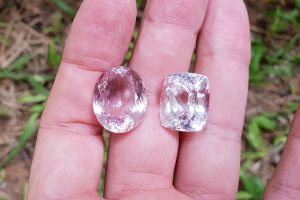
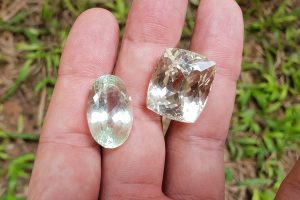
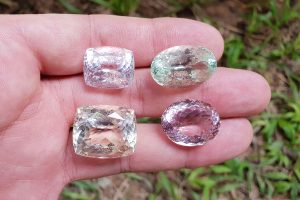
Varieties by colour: Green = Emerald · Blue = Aquamarine · Pink = Morganite · Yellow = Heliodor · Colourless = Goshenite · Red = Red beryl · Blue = Maxixe
RI1.560–1.600Birefringence0.005–0.009SG2.67–2.90Hardness7.5–8.0Optic characterDR U-Crystal systemHexagonalTransparencyTransparent to opaqueUV long-wavenon – stUV short-wavenon – stColoursGreen, Blue, Pink, Yellow, Colourless, Orange, Red, Brown, White
In the GEMIC gem encyclopedia (photos & video):
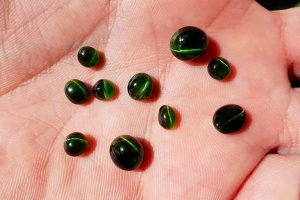
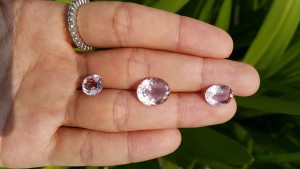
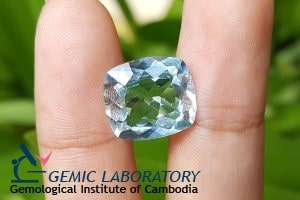
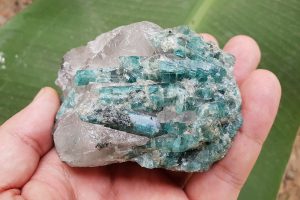
EmeraldHeliodorGosheniteMorganiteAquamarineTrapiche EmeraldGreenish blue berylCat's eye aquamarineBlue beryl irradiatedGreen beryl irradiated
Synthetic morganiteSynthetic red berylSynthetic aquamarinelab created emeraldsSynthetic bicolor berylSynthetic neon blue beryl
Separation (nat. / syn. / imitations): Flux synthetic emerald: wispy flux veils, platinum platelets, phenakite crystals; RI/SG at the LOW end of beryl range; strong red UV (no iron quench).
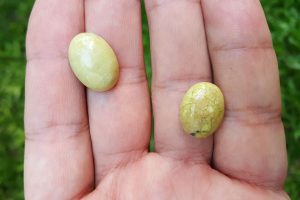
Variscite
RI1.554–1.593Birefringence—SG2.20–2.60Hardness3.5–5.0Optic characterAGGCrystal systemOrthorhombicTransparencyTranslucent to opaqueUV long-wavenon – wkUV short-wavenon – wkColoursGreen, White
Separation (nat. / syn. / imitations): Synthetic amethyst/citrine: 'breadcrumb' pinpoints, no Brazil twinning, seed plate traces — separation can be difficult, lab check for important stones. Most citrine = heated amethyst.
Easily confused with: Amethyst vs purple scapolite/fluorite; citrine vs topaz; rock crystal vs colourless topaz/glass.
Syn. QuartzSYNTHETIC
Hydrothermal
Growth method: Grown from hot aqueous solution — look for chevron / zig-zag growth zoning and seed-plate remnants.
Separation (nat. / syn. / imitations): Assembled stones (doublets/triplets): join line at or near the girdle, flattened gas bubbles in the cement plane, colour concentrated in cement — immerse and view side-on. Garnet-topped doublets: red rim seen table-down on white paper.
Easily confused with: Any stone whose crown and pavilion give different readings.
⚠ Below: close, but NOT fully compatible. Each material in this second group fails exactly one measurement, by a small margin (shown in red on its card). It is kept only in case of a measuring error — re-check that reading before considering these candidates.
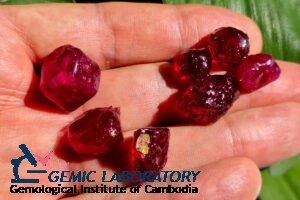
RubyVARIETY OF CORUNDUM
The red gem variety of corundum, coloured by chromium.
Colour — defining featureRedRI1.757–1.779Birefringence0.008–0.010SG3.95–4.10Hardness9.0Optic characterDR U-Crystal systemTrigonalTransparencyTransparent to opaqueUV long-wavenon – stUV short-wavenon – st
In the GEMIC gem encyclopedia (photos & video):
Star rubyTrapiche rubyGlass filled ruby
Species constants above apply.Open the full Corundum species card →
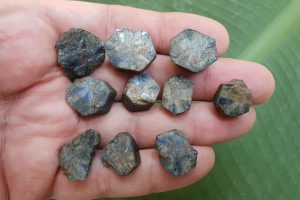
SapphireVARIETY OF CORUNDUM
The blue variety of corundum; 'fancy sapphires' cover every other corundum colour.
Colour — defining featureBlueRI1.757–1.779Birefringence0.008–0.010SG3.95–4.10Hardness9.0Optic characterDR U-Crystal systemTrigonalTransparencyTransparent to opaqueUV long-wavenon – stUV short-wavenon – st
In the GEMIC gem encyclopedia (photos & video):
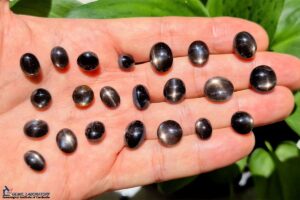
Star sapphireBlue sapphireGreen SapphireTrapiche sapphireBlack star sapphireColor change sapphire
Species constants above apply.Open the full Corundum species card →
Padparadscha sapphireVARIETY OF CORUNDUM
Rare pinkish-orange sapphire variety.
Colour — defining featurePink / OrangeRI1.757–1.779Birefringence0.008–0.010SG3.95–4.10Hardness9.0Optic characterDR U-Crystal systemTrigonalTransparencyTransparent to opaqueUV long-wavenon – stUV short-wavenon – st
In the GEMIC gem encyclopedia (photos & video):
Star rubyTrapiche ruby
Species constants above apply.Open the full Corundum species card →
Star rubyVARIETY OF CORUNDUM
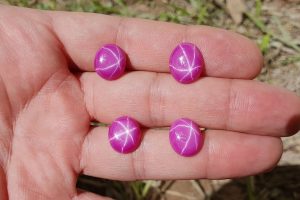
Ruby showing a six-ray star (asterism) from oriented rutile silk.
Colour — defining featureRedRI1.757–1.779Birefringence0.008–0.010SG3.95–4.10Hardness9.0Optic characterDR U-Crystal systemTrigonalTransparencyTransparent to opaqueUV long-wavenon – stUV short-wavenon – st
In the GEMIC gem encyclopedia (photos & video):
Species constants above apply.Open the full Corundum species card →
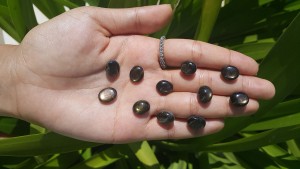
Star sapphireVARIETY OF CORUNDUM
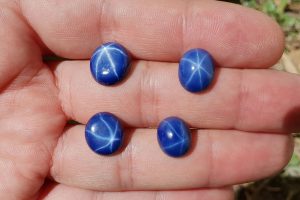
Sapphire with six-ray asterism from rutile silk.
Colour — defining featureBlue / Grey / BlackRI1.757–1.779Birefringence0.008–0.010SG3.95–4.10Hardness9.0Optic characterDR U-Crystal systemTrigonalTransparencyTransparent to opaqueUV long-wavenon – stUV short-wavenon – st
In the GEMIC gem encyclopedia (photos & video):
Star sapphireBlack star sapphire
Species constants above apply.Open the full Corundum species card →
EmeraldVARIETY OF BERYL
The green beryl variety, coloured by chromium and/or vanadium.
Colour — defining featureGreenRI1.560–1.600Birefringence0.005–0.009SG2.67–2.90Hardness7.5–8.0Optic characterDR U-Crystal systemHexagonalTransparencyTransparent to opaqueUV long-wavenon – stUV short-wavenon – st
In the GEMIC gem encyclopedia (photos & video):
EmeraldTrapiche Emerald
Species constants above apply.Open the full Beryl species card →
AquamarineVARIETY OF BERYL
Light blue to sea-green beryl, coloured by iron.
Colour — defining featureBlueRI1.560–1.600Birefringence0.005–0.009SG2.67–2.90Hardness7.5–8.0Optic characterDR U-Crystal systemHexagonalTransparencyTransparent to opaqueUV long-wavenon – stUV short-wavenon – st
In the GEMIC gem encyclopedia (photos & video):
AquamarineCat's eye aquamarine
Species constants above apply.Open the full Beryl species card →
MorganiteVARIETY OF BERYL
Pink to peach beryl, coloured by manganese.
Colour — defining featurePinkRI1.560–1.600Birefringence0.005–0.009SG2.67–2.90Hardness7.5–8.0Optic characterDR U-Crystal systemHexagonalTransparencyTransparent to opaqueUV long-wavenon – stUV short-wavenon – st
In the GEMIC gem encyclopedia (photos & video):
Species constants above apply.Open the full Beryl species card →
HeliodorVARIETY OF BERYL
Yellow to golden beryl, coloured by iron.
Colour — defining featureYellowRI1.560–1.600Birefringence0.005–0.009SG2.67–2.90Hardness7.5–8.0Optic characterDR U-Crystal systemHexagonalTransparencyTransparent to opaqueUV long-wavenon – stUV short-wavenon – st
In the GEMIC gem encyclopedia (photos & video):
Species constants above apply.Open the full Beryl species card →
GosheniteVARIETY OF BERYL
The colourless, pure variety of beryl.
Colour — defining featureColourlessRI1.560–1.600Birefringence0.005–0.009SG2.67–2.90Hardness7.5–8.0Optic characterDR U-Crystal systemHexagonalTransparencyTransparent to opaqueUV long-wavenon – stUV short-wavenon – st
In the GEMIC gem encyclopedia (photos & video):
Species constants above apply.Open the full Beryl species card →
Red berylVARIETY OF BERYL
Very rare red beryl (manganese), best known from Utah.
Colour — defining featureRedRI1.560–1.600Birefringence0.005–0.009SG2.67–2.90Hardness7.5–8.0Optic characterDR U-Crystal systemHexagonalTransparencyTransparent to opaqueUV long-wavenon – stUV short-wavenon – st
In the GEMIC gem encyclopedia (photos & video):
EmeraldHeliodor
Species constants above apply.Open the full Beryl species card →
MaxixeVARIETY OF BERYL
Deep blue beryl whose colour fades in daylight — buy with caution.
Colour — defining featureBlueRI1.560–1.600Birefringence0.005–0.009SG2.67–2.90Hardness7.5–8.0Optic characterDR U-Crystal systemHexagonalTransparencyTransparent to opaqueUV long-wavenon – stUV short-wavenon – st
In the GEMIC gem encyclopedia (photos & video):
EmeraldHeliodor
Species constants above apply.Open the full Beryl species card →
AmethystVARIETY OF QUARTZ
The purple variety of quartz (iron + natural irradiation).
Species constants above apply.Open the full Pyrope-Spessartine species card →
Mali garnetVARIETY OF GROSSULAR-ANDRADITE
Yellow-green grossular-andradite garnet from Mali.
Colour — defining featureYellow / Green / BrownRI1.773–1.779Birefringence—SG3.66–3.68Hardness7.0–7.5Optic characterSRCrystal systemCubicTransparencyTransparent to opaqueUV long-wavenonUV short-wavenon
In the GEMIC gem encyclopedia (photos & video):
Star garnetPyrope garnet
Species constants above apply.Open the full Grossular-Andradite species card →
AlexandriteVARIETY OF CHRYSOBERYL
Colour-change chrysoberyl: green in daylight, red under incandescent light. A chatoyant form also exists — cat’s-eye alexandrite, combining colour change and chatoyancy.
Species constants above apply.Open the full Diopside species card →
ChiastoliteVARIETY OF ANDALUSITE
Andalusite with a dark carbon cross seen in section (cross-stone).
Colour — defining featureBrown / GreyRI1.629–1.648Birefringence0.007–0.013SG3.13–3.21Hardness7.0–7.5Optic characterDR B- / AGGCrystal systemOrthorhombicTransparencyTransparent to opaqueUV long-wavenonUV short-wavenon – mod
In the GEMIC gem encyclopedia (photos & video):
Species constants above apply.Open the full Andalusite species card →
0 excluded materials — see why
«» is a gem variety of the species The property card below describes the species; colour-specific varieties share these constants.
Properties
Choose a gem above to display its full property card.
Stones with close properties — and how to separate them
Send my observation file to GEMIC
Your observations and the remaining candidates are attached automatically. Tell us who you are and what you need — requests without a clear question cannot be answered.
Please enter your name, a valid email address, and a question of at least 15 characters.
Very high = ranges do not overlap: this single test separates the two materials. Colour is never conclusive on its own.
GEMIC ◆ GEMOLOGICAL ASSISTANT
Gemological Institute of Cambodia (GEMIC Institute) · Rose Apple Square, Siem Reap, Cambodia · gem.agency
Self-Examination Worksheet
Date: · Examiner: ______________________
Recorded observations
Result
material(s) remain consistent with these observations:
Important. This worksheet is a personal self-assessment produced with the free GEMIC Gemological Assistant. It is not a laboratory report, carries no guarantee from GEMIC Institute, and must not be presented as a certificate. Results indicate compatibility with recorded observations only. For a certified identification report, submit the stone to the GEMIC Institute laboratory: gem.agency/contact-us